Do you know about BIMP-EAGA?
BIMP-EAGA: Something You Might Not Have Heard Of
I think many of you might not have heard of BIMP-EAGA.
BIMP-EAGA stands for Brunei-Indonesia-Malaysia-Philippines-East ASEAN Growth Area, which is referred to in Japanese as "東ASEAN成長地帯".
Despite often being involved in projects in Southeast Asia, I, embarrassingly, didn't know about BIMP-EAGA and didn't even know how to pronounce it. I first learned about BIMP-EAGA when the Brunei project started. It is pronounced "Bimp-Earga".
As the initials suggest, BIMP-EAGA is an economic zone consisting of Brunei, Indonesia, Malaysia, and the Philippines, as shown in Figure 1 on the map. It is clear that it is the economic area at the eastern end of ASEAN.
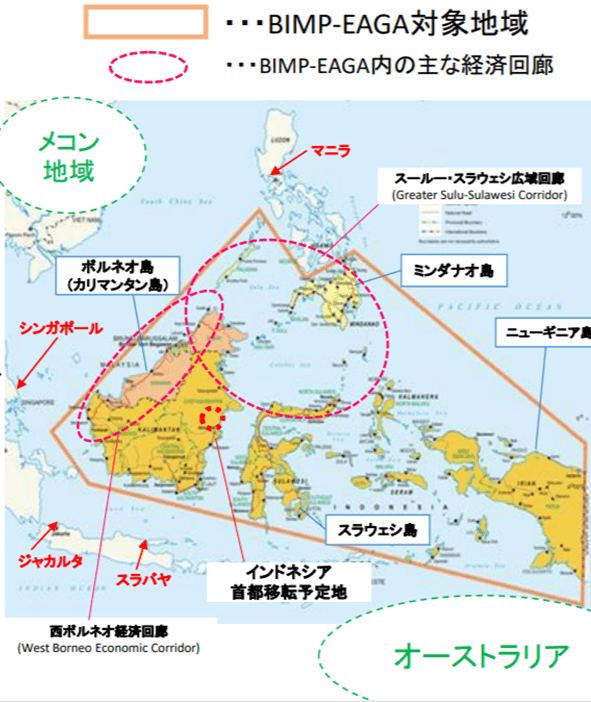
Figure 1: Map of BIMP-EAGA
Source: Consulate General in Davao materials ( https://www.davao.ph.emb-japan.go.jp/files/100151779.pdf )
Overview of BIMP-EAGA: Four times the area of Japan, with a relatively small population of just under 80 million
BIMP-EAGA was established in 1994, and it has nearly 30 years of history. Through infrastructure development (transportation and electricity) in the region, it aims to promote trade, investment, and industry (agriculture and tourism). It also cooperates in areas such as environment, society, culture, and education.
The relevant areas include the entire nation of Brunei Darussalam, Kalimantan, Sulawesi, Maluku, and West Papua in Indonesia, the states of Sabah and Sarawak in Malaysia, and the federal territory of Labuan, as well as Mindanao and Palawan in the Philippines.
Although the entire country of Brunei is included, its land area is 5,765 square kilometers (roughly the same size as Mie Prefecture) and has a population of 437,500, making it a small country. For Indonesia, Malaysia, and the Philippines, the regions are also sparsely populated and far from the capitals. The total land area of BIMP-EAGA is 1.6 million square kilometers (4.2 times that of Japan, and one-third of the ASEAN region), but its population is relatively small at about 79.84 million.
Despite a small economy, it is steadily expanding
The size of the economy is also not substantial, as the GDP in 2020 was $322.8 billion. For reference, the country with the highest GDP ranking, the United States, has $20.8938 trillion, followed by China with $14.8667 trillion, and Japan with $5.4051 trillion, while Bangladesh, ranked 42nd and similar in size to BIMP-EAGA, has a GDP of $323 billion.
However, the economy of BIMP-EAGA has grown steadily since its inception in 1994, with a GDP of $322.8 billion in 2020, an increase of 112.36% from $287.3 billion in 2017, marking double-digit growth. Although it has been affected by the COVID-19 pandemic, foreign direct investment reached $12.8 billion in 2020 (132.0% year-on-year), and domestic investment reached $9.2 billion (133.3% year-on-year), indicating that it is an attractive economic area with high investor interest.
Infrastructure projects underway in the region: The Temburong Bridge is completed
In fact, there are many infrastructure projects related to BIMP-EAGA, totaling $24.23 billion as of October 2021. As an example, the Temburong Bridge in Brunei was completed in March 2020. This massive bridge spans 30 square kilometers and greatly improved access between the capital, Bandar Seri Bagawan, and the enclave of Temburong (a region known for its rich nature and advancing smart city developments). Our company staff traveled to Brunei in July 2021 and crossed the Temburong Bridge. We will also share local scenery and videos (Figures 2 to 6).
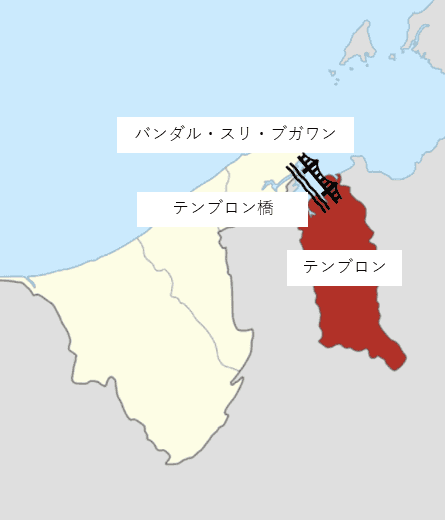
Figure 2: Map of Temburong and the Temburong Bridge
Source: Created by our company based on Wikipedia maps
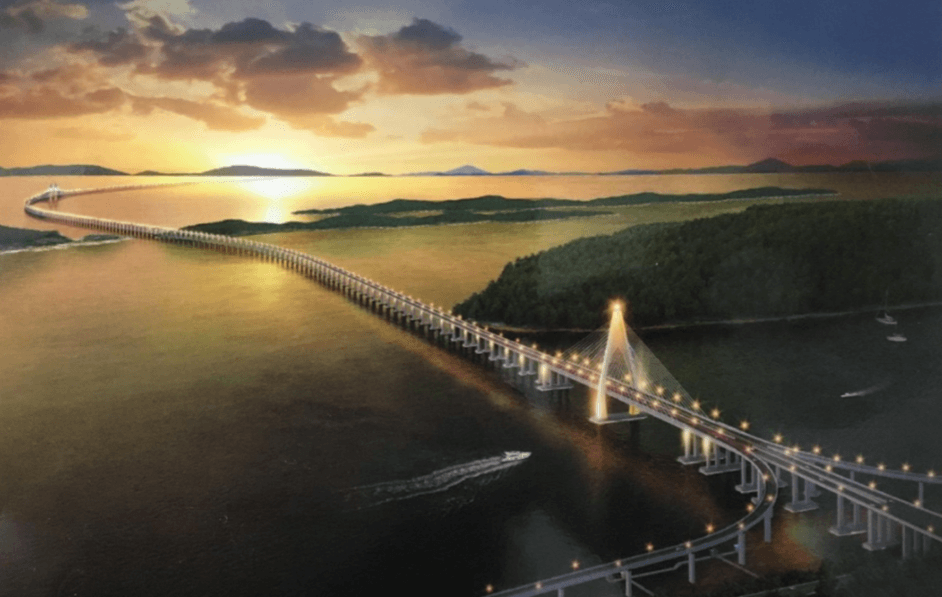
Figure 3: Image of Temburong Bridge
Source: ERIA Full Report – Formulation of Temburong Eco Town
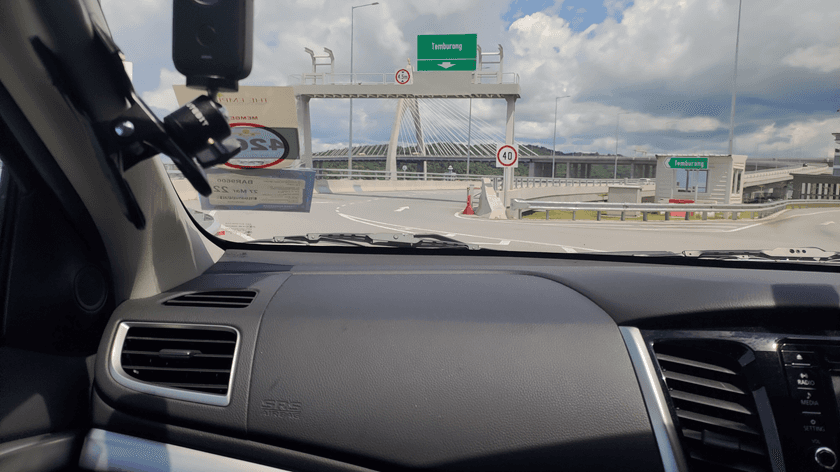
Figure 4: Brunei Trip ①: Entrance to the Temburong Bridge side from Bandar Seri Bagawan

Figure 5: Brunei Trip ②: Crossing the Temburong Bridge
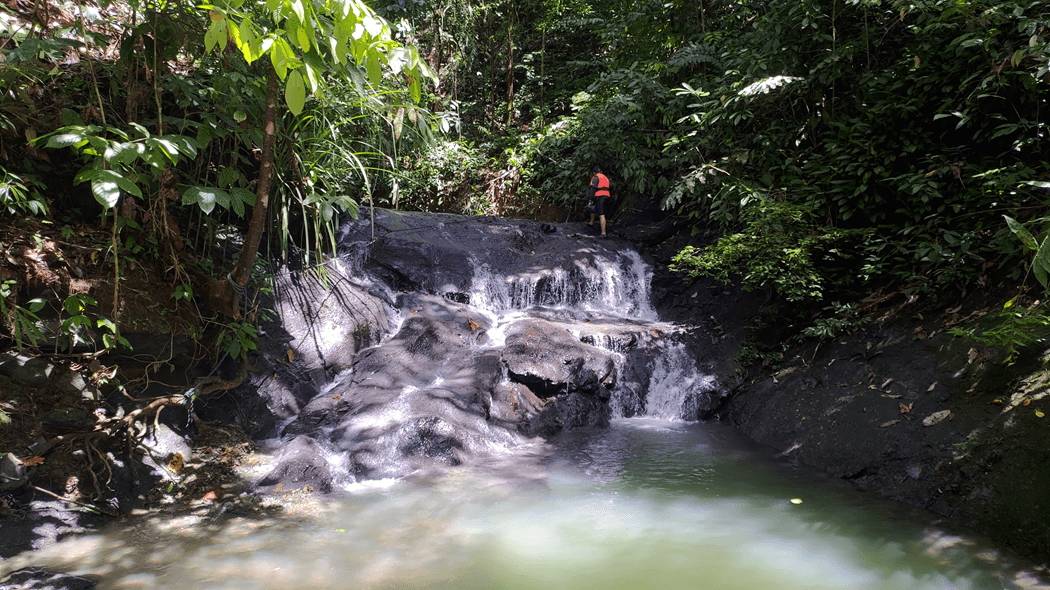
Figure 6: Nature in Brunei: Participating in a waterfall climbing tour
Reference: Video of crossing the Temburong Bridge / Hiroshi Okouchi's YouTube
The Appeal of BIMP-EAGA: Nature as a Tourist Resource
While BIMP-EAGA has a small population and its economy is still small, as seen in the scenery of Temburong introduced earlier, it is a region rich in nature and tourism appeal. In addition to Temburong, the region has abundant tourist resources such as Kota Kinabalu, the capital of Sabah in Malaysia, known for Mount Kinabalu and marine resorts, and Palawan in the Philippines, considered one of the most beautiful islands in the world.
Attention to the Relocation of Indonesia's Capital to BIMP-EAGA
Another recent topic is that on January 18, 2022, the Indonesian parliament approved the relocation of the capital from the current Jakarta to East Kalimantan, which is included in BIMP-EAGA.
Due to the serious issues of overpopulation and traffic congestion in Jakarta, the Indonesian government plans to develop 250,000 hectares of forest in East Kalimantan and gradually begin transferring the capital functions from 2024. The new capital will be named "Nusantara," meaning "archipelago" in Indonesian (the location of the new capital is referenced in Figure 1). Indonesia is the world's fourth-largest country with a population of 270 million. Its new capital will be in BIMP-EAGA, and it is ironically an archipelago as well.
2022 could be the year of the archipelago power, and focusing on BIMP-EAGA could be interesting; "Don't you know about BIMP-EAGA? It's a region worth watching!"