Dec 18, 2025
Edge AI Devices (Jetson-equipped) and General-purpose PCs (RTX-equipped) — What Are the Differences and Why Use Them Separately?
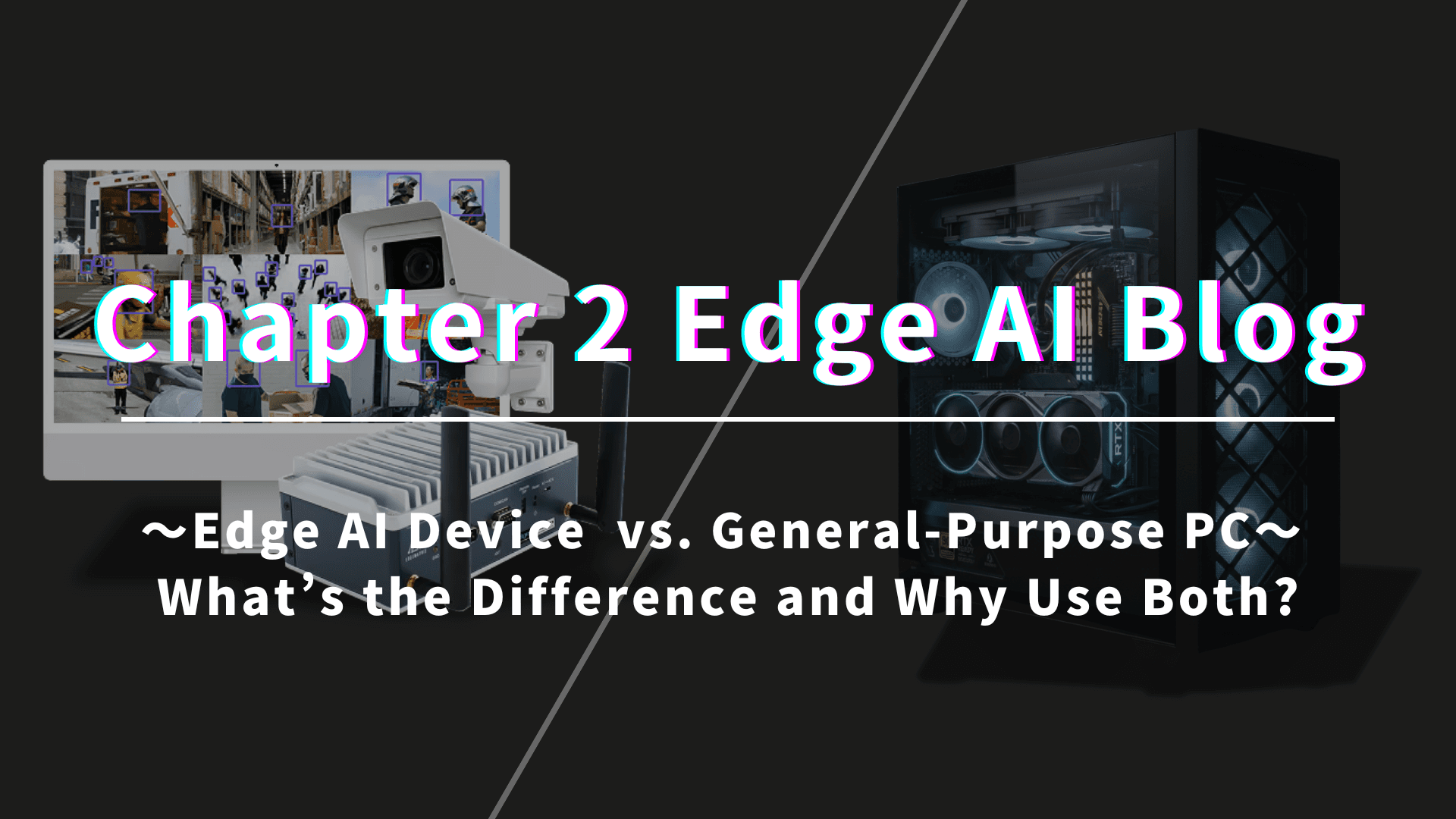
Edge AI devices and typical general-purpose PCs (desktop PCs/laptops) are both broadly speaking "computers." However, their design philosophies, environments in which they are used, and their strengths and applications differ significantly. This article will clarify the differences (suitability and unsuitability) using NVIDIA's "Jetson" and "RTX"—names frequently mentioned in video AI—while explaining why "edge AI devices" are chosen.
Table of Contents
First clarification: Edge AI devices are also "a type of PC"
Differences between Jetson and RTX (suitability and unsuitability)
What RTX-equipped general-purpose PCs excel at (and price perspective)
Reasons why edge AI devices are still needed
Challenges that arise when substituting with RTX-equipped PCs
Reasons Zenmov × EDGEMATRIX can claim "easy operation"
Summary
Supplement: Why NVIDIA is often used in edge AI (CUDA ecosystem/CUDA Tile)
1. First clarification: Edge AI devices are also "a type of PC"
Edge AI devices (edge PCs, industrial AI devices, etc.) have a basic computer structure that is the same as general-purpose PCs in terms of input (camera footage/sensors) → processing (AI inference) → output (notifications/control/storage). However, since the term "PC" usually refers to desktop PCs/laptops used in offices or homes, for the sake of distinction, this article refers to "general-purpose PCs (RTX-equipped PCs)" and "edge AI devices (Jetson-equipped devices)."
In summary,
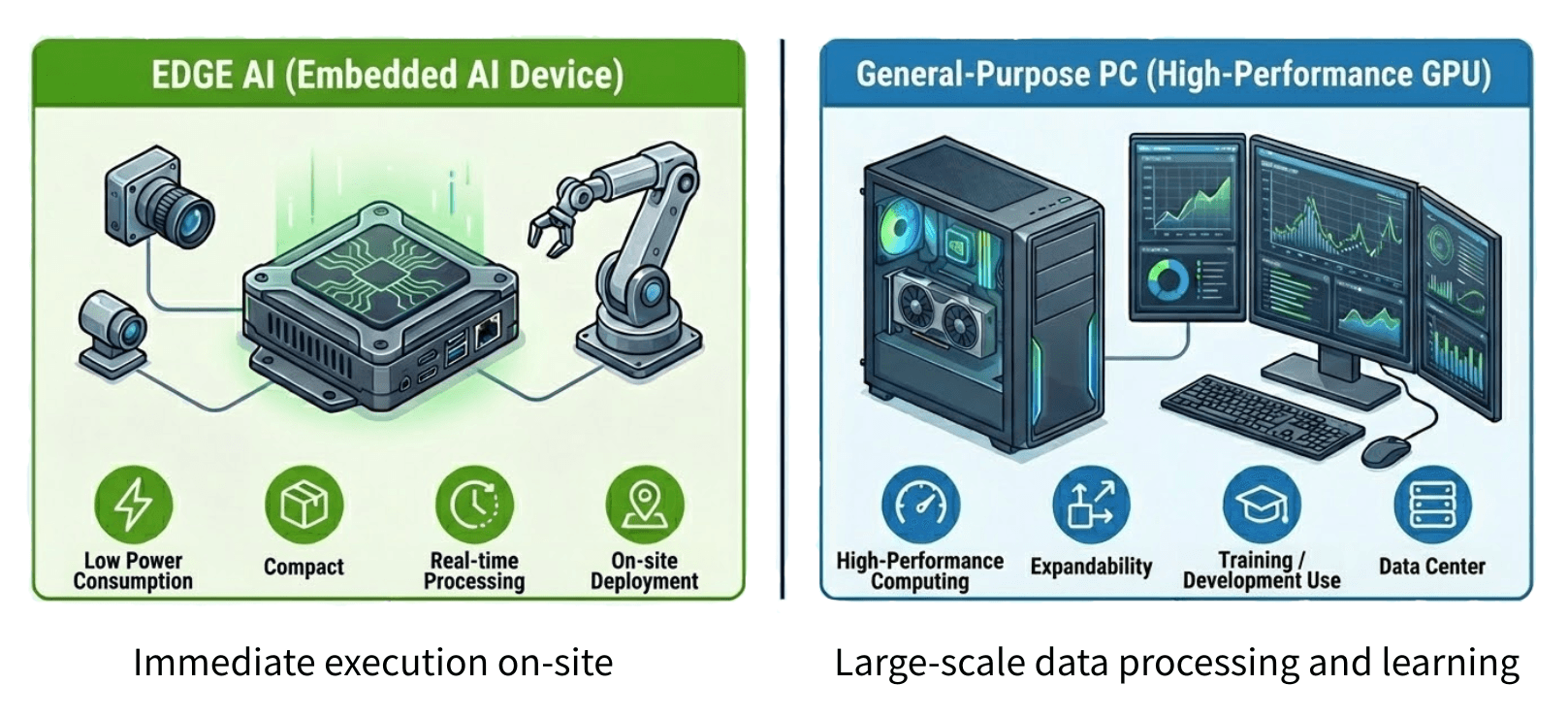
General-purpose PC (RTX-equipped): A "high-performance general PC" that is designed to operate in a stable indoor environment and can handle a wide range of applications.
Edge AI Device (Jetson-equipped): A "purpose-specific PC" optimized for on-site use.
2. Differences between Jetson and RTX
Here, we will look at the NVIDIA products commonly mentioned in video analytics. Jetson is a "compact computer designed to be placed on-site," while RTX is a "high-performance GPU card inserted into PCs and servers."
Jetson (for edge)
Edge-oriented platform integrating ARM CPU and GPU
Compact, energy-efficient, and designed for continuous operation (assuming on-site installation)
Can easily achieve real-time inference on-site when combined with cameras and sensors
Often embedded in devices that have environmental resistance (dust-proof, vibration-resistant, etc.)
RTX (for general PCs/servers)
Mainly a discrete GPU (card) mounted in PCs/servers
Outstanding GPU performance and price competitiveness are attractive (versatile usage)
Can accommodate "general purposes" such as PC work, development environments, and validation
However, the installation environment is generally indoor (assuming power, air conditioning, and chassis space)
3. What RTX-equipped general-purpose PCs excel at (and price perspective)
In conclusion, RTX-equipped general-purpose PCs are very attractive in terms of "performance" and "price." In particular, in environments that can operate PoCs (proof of concept) or in air-conditioned server rooms and offices, they become a realistic choice.
Performance: With high GPU performance, they can easily handle a wide range from video analysis to verification of large-scale models
Flexibility: With general-purpose OS (Windows/Linux, etc.), software can be freely configured according to specific needs
Cost: If aiming for similar levels of inference performance, depending on configuration, there may be cases that are "cost-effective"
Standard PC tasks (development, editing, analysis, etc.) can also be handled on the same machine
〈Price perspective as of 2025〉
Prices greatly vary based on the generation of the GPU, CPU, memory, chassis (industrial or not), and acquisition channels (retail/BTO/business-oriented). Here, as a reference, we outline the ranges typically seen domestically.
Category | Price Range (new) | Notes |
Desktop PC with RTX | Center around 120,000 to 350,000 yen (high-end models may exceed 500,000 yen) | Available widely through BTO/retail. Prices can fluctuate based on GPU generation and surrounding configurations. |
Edge PC with Jetson (typical compact model) | Around 200,000 to 400,000 yen | Many configurations prioritize compactness and energy efficiency. |
Industrial or rugged edge PC with Jetson | Could range from around 300,000 to over 800,000 yen | These are more prone to price increases based on "chassis requirements" such as dust-proofing and vibration resistance. |
It is not uncommon for "RTX-equipped PCs to appear higher-performing and more affordable." Nevertheless, the choice of edge AI devices is largely influenced by the “operational conditions” discussed in the next section.
4. Reasons why edge AI devices are still needed
Simply running AI can be done with general-purpose PCs. For example, detecting "a car is in the image" or "a person has passed" can be processed by an office PC.
On the other hand, edge AI truly demonstrates its value when certain on-site conditions are met.
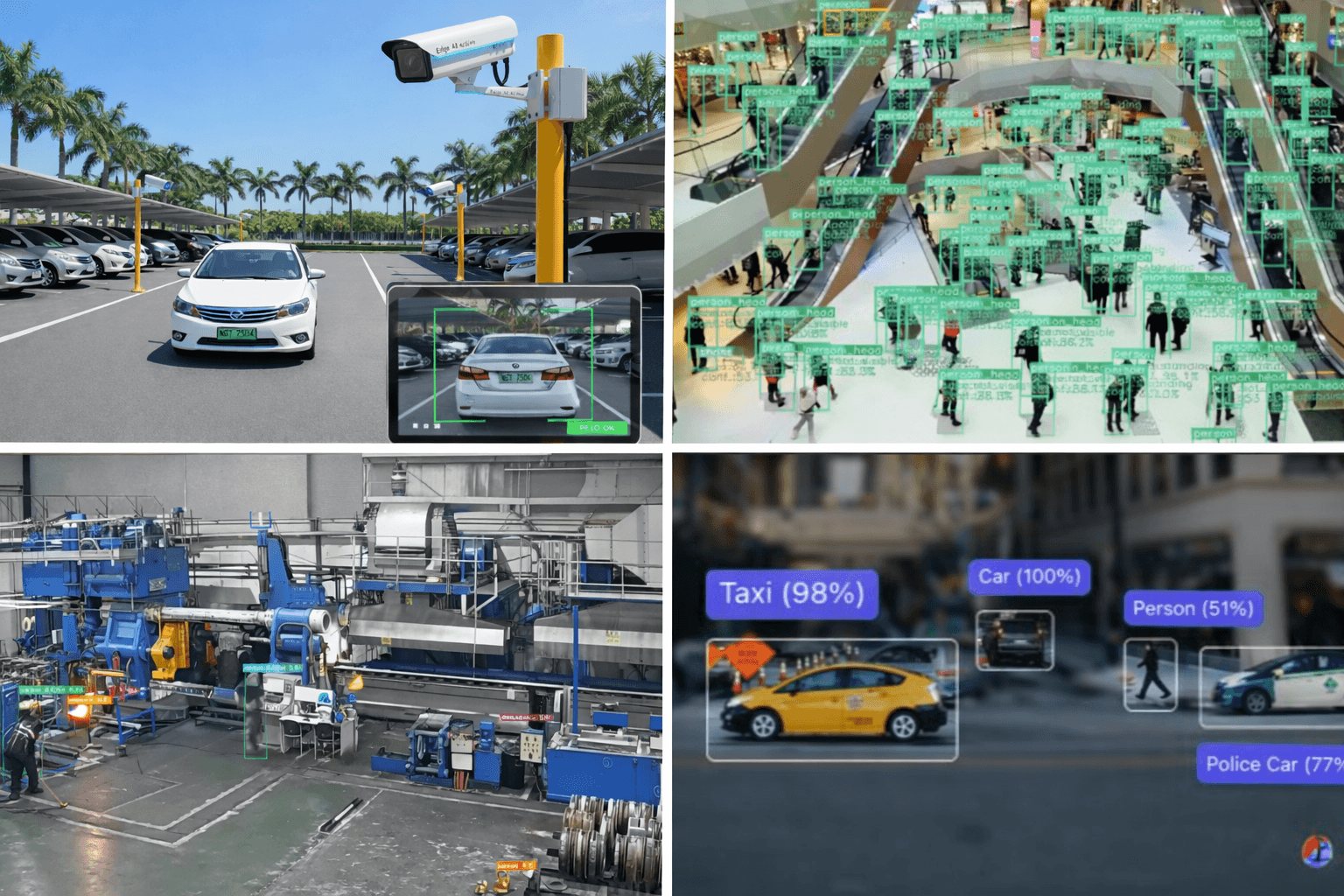
Installed in "the field" such as parking lots, factories, stores, roads, and entrances to facilities
Required to continuously operate 24/7 without stopping
Face harsh environmental conditions such as heat, cold, dust, and vibration
Limited power supply and installation space (energy efficiency and compactness are essential)
The edge AI devices (edge PCs) were created to fulfill these requirements. While edge devices are also PCs, they specialize in areas that are commonly employed with AI (such as GPUs) and minimize elements that may be unnecessary on-site, thus enhancing cost performance and operational capability for continuous inference.
Next, comparing Jetson and RTX reveals clearer differences.
5. Challenges that arise when substituting with RTX-equipped PCs
It is a natural thought to consider, "Isn't it fine to place a general-purpose PC with RTX instead of Jetson on-site?" However, when trying to meet the "field requirements" that edge AI must fulfill, the following challenges tend to arise.
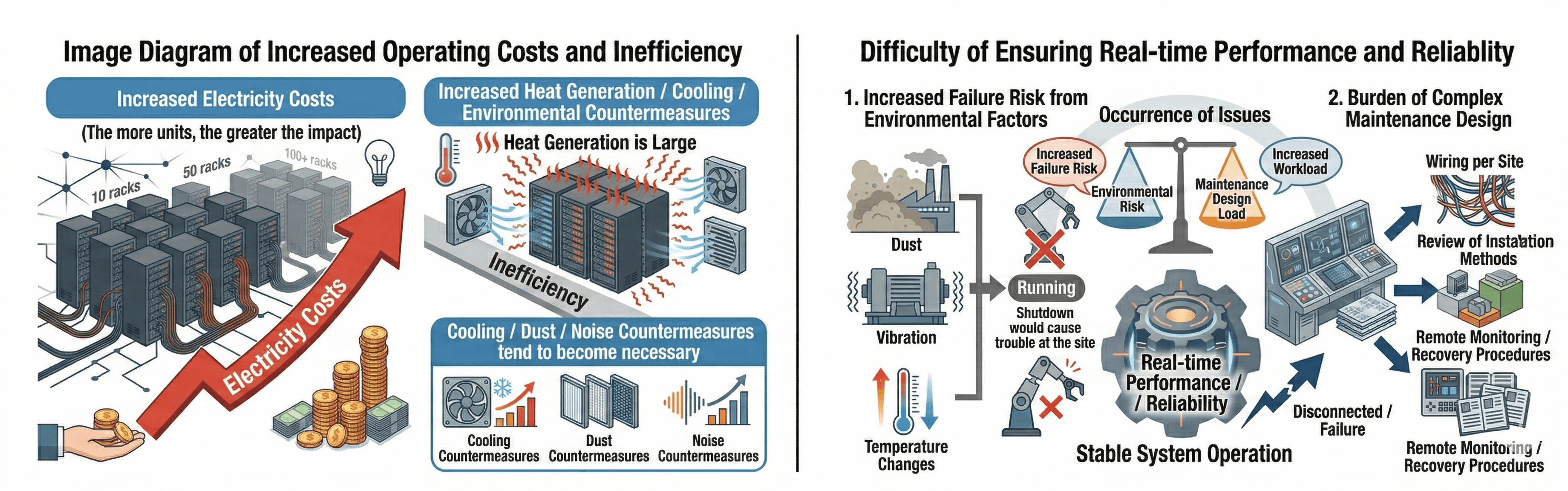
① Increased operational costs and inefficiencies
Energy costs can rise significantly (the larger the number of units, the greater the impact)
High heat generation, thus making cooling, dust-proofing, and noise reduction necessary
It becomes difficult to install in outdoor or vehicle-mounted locations where there are restrictions on power and space
② Difficulty in ensuring real-time performance and reliability
Risk of failure increases due to dust, vibration, temperature changes, etc. (If it stops, the site faces issues)
Need to independently develop design and monitoring for continuous operation involving OS updates and restarts
Increased maintenance designs for wiring, installation, remote monitoring, and recovery procedures unique to each site
In summary, while RTX-equipped PCs boast high processing performance, it is challenging to operate them continuously on-site without stopping 24/7. Additionally, there is a heavy burden associated with needing to construct everything from operational design to maintenance and upkeep from scratch. The value of edge AI devices lies in their ability to absorb such burdens as a "product," making on-site implementation more accessible.
6. Reasons Zenmov × EDGEMATRIX can claim "easy operation"
Up to this point, the question, "Why do we need edge devices when RTX often offers high performance and low cost?" has likely become more specific. When considering everything including operational aspects, edge AI devices are "PCs packaged with the premise of AI's on-site operation," resulting in a significant change in the burden after deployment.
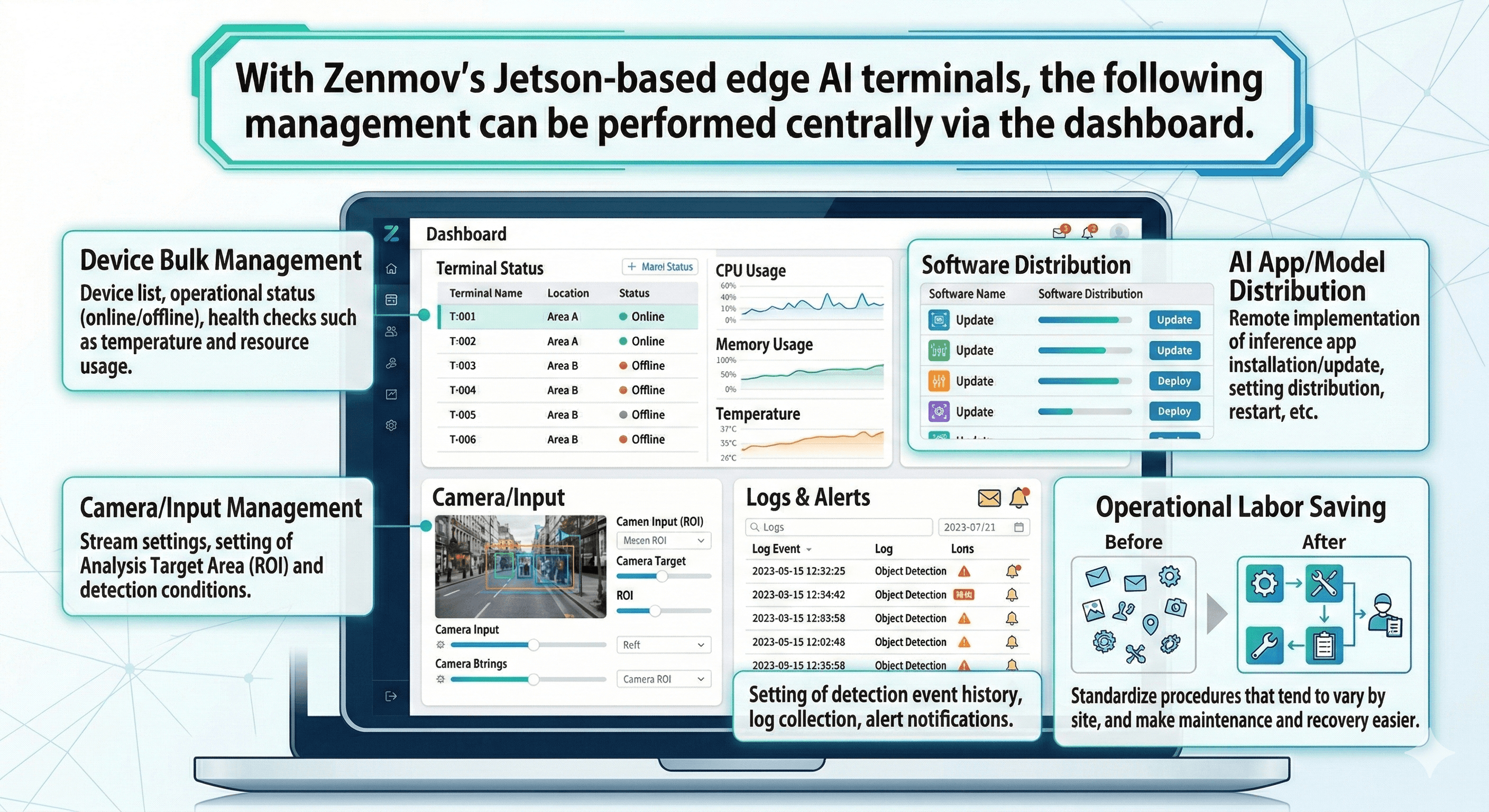
The Jetson-based edge AI devices offered by Zenmov allow for management centered around a dashboard, including the following:
Centralized terminal management: List of devices, operational status (online/offline), health checks such as temperature and resource usage
Distribution of AI apps/models: Remote implementation of installation, updates, configuration distribution, and reboots for inference applications
Camera/input management: Stream settings, area of analysis (ROI), and setting detection conditions
Alerts/logs: History of detection events, log collection, and alert notification settings
Simplification of operation: Standardizing procedures that tend to vary by site to facilitate maintenance and recovery
It is also possible to aim for similar operations with general-purpose PCs (RTX-equipped), but this requires "self-designed" handling of monitoring, updates, log collection, and recovery during failures—a process that becomes more burdensome as the scale increases.
7. Summary
RTX-equipped general-purpose PCs excel at balancing performance and price, making them very powerful for PoCs and indoor operations. On the other hand, edge AI devices are designed with assumptions of "energy efficiency, environmental resistance, continuous operation, and remote operation," making them valuable for cases of keeping operations running without interruption in the field, providing comprehensive reliability and reduced operational burdens.
Testing and validation indoors: RTX-equipped PCs are powerful (high performance, flexible, cost-effective)
Continuous operation on-site: Jetson-equipped edge AI devices are powerful (energy-efficient, environment-resistant, standardized operation)
Supplement: Why NVIDIA is often used in edge AI (CUDA ecosystem)
The frequent use of NVIDIA products in the edge AI domain is due not only to hardware performance but also the presence of a robust "CUDA ecosystem (development infrastructure)" that strongly supports development.
CUDA ecosystem: The parallel computing infrastructure "CUDA" is widely used as a de facto standard in AI/deep learning fields.
Compatibility with major frameworks: Major frameworks like TensorFlow and PyTorch are optimized for NVIDIA GPUs, facilitating the transition from training to inference.
Rich libraries/SDKs: There are abundant SDKs for image recognition, video processing, inference optimization, robotics, etc., leading to reduced development time and costs.
As a result, there is an advantage in easily connecting training (server-side) and inference (edge-side) within the same NVIDIA stack, making overall operational forecasts easier.
In recent years, initiatives have also progressed to make CUDA more accessible to Python users through the introduction of "CUDA Tile (tile-based programming model)" in CUDA Toolkit 13.1 and "cuTile Python" for Python users.
Edge AI Devices (Jetson-equipped) and General-purpose PCs (RTX-equipped) — What Are the Differences and Why Use Them Separately?

Edge AI devices and typical general-purpose PCs (desktop PCs/laptops) are both broadly speaking "computers." However, their design philosophies, environments in which they are used, and their strengths and applications differ significantly. This article will clarify the differences (suitability and unsuitability) using NVIDIA's "Jetson" and "RTX"—names frequently mentioned in video AI—while explaining why "edge AI devices" are chosen.
Table of Contents
First clarification: Edge AI devices are also "a type of PC"
Differences between Jetson and RTX (suitability and unsuitability)
What RTX-equipped general-purpose PCs excel at (and price perspective)
Reasons why edge AI devices are still needed
Challenges that arise when substituting with RTX-equipped PCs
Reasons Zenmov × EDGEMATRIX can claim "easy operation"
Summary
Supplement: Why NVIDIA is often used in edge AI (CUDA ecosystem/CUDA Tile)
1. First clarification: Edge AI devices are also "a type of PC"
Edge AI devices (edge PCs, industrial AI devices, etc.) have a basic computer structure that is the same as general-purpose PCs in terms of input (camera footage/sensors) → processing (AI inference) → output (notifications/control/storage). However, since the term "PC" usually refers to desktop PCs/laptops used in offices or homes, for the sake of distinction, this article refers to "general-purpose PCs (RTX-equipped PCs)" and "edge AI devices (Jetson-equipped devices)."
In summary,
General-purpose PC (RTX-equipped): A "high-performance general PC" that is designed to operate in a stable indoor environment and can handle a wide range of applications.
Edge AI Device (Jetson-equipped): A "purpose-specific PC" optimized for on-site use.
2. Differences between Jetson and RTX
Here, we will look at the NVIDIA products commonly mentioned in video analytics. Jetson is a "compact computer designed to be placed on-site," while RTX is a "high-performance GPU card inserted into PCs and servers."
Jetson (for edge)
Edge-oriented platform integrating ARM CPU and GPU
Compact, energy-efficient, and designed for continuous operation (assuming on-site installation)
Can easily achieve real-time inference on-site when combined with cameras and sensors
Often embedded in devices that have environmental resistance (dust-proof, vibration-resistant, etc.)
RTX (for general PCs/servers)
Mainly a discrete GPU (card) mounted in PCs/servers
Outstanding GPU performance and price competitiveness are attractive (versatile usage)
Can accommodate "general purposes" such as PC work, development environments, and validation
However, the installation environment is generally indoor (assuming power, air conditioning, and chassis space)
3. What RTX-equipped general-purpose PCs excel at (and price perspective)
In conclusion, RTX-equipped general-purpose PCs are very attractive in terms of "performance" and "price." In particular, in environments that can operate PoCs (proof of concept) or in air-conditioned server rooms and offices, they become a realistic choice.
Performance: With high GPU performance, they can easily handle a wide range from video analysis to verification of large-scale models
Flexibility: With general-purpose OS (Windows/Linux, etc.), software can be freely configured according to specific needs
Cost: If aiming for similar levels of inference performance, depending on configuration, there may be cases that are "cost-effective"
Standard PC tasks (development, editing, analysis, etc.) can also be handled on the same machine
〈Price perspective as of 2025〉
Prices greatly vary based on the generation of the GPU, CPU, memory, chassis (industrial or not), and acquisition channels (retail/BTO/business-oriented). Here, as a reference, we outline the ranges typically seen domestically.
Category | Price Range (new) | Notes |
Desktop PC with RTX | Center around 120,000 to 350,000 yen (high-end models may exceed 500,000 yen) | Available widely through BTO/retail. Prices can fluctuate based on GPU generation and surrounding configurations. |
Edge PC with Jetson (typical compact model) | Around 200,000 to 400,000 yen | Many configurations prioritize compactness and energy efficiency. |
Industrial or rugged edge PC with Jetson | Could range from around 300,000 to over 800,000 yen | These are more prone to price increases based on "chassis requirements" such as dust-proofing and vibration resistance. |
It is not uncommon for "RTX-equipped PCs to appear higher-performing and more affordable." Nevertheless, the choice of edge AI devices is largely influenced by the “operational conditions” discussed in the next section.
4. Reasons why edge AI devices are still needed
Simply running AI can be done with general-purpose PCs. For example, detecting "a car is in the image" or "a person has passed" can be processed by an office PC.
On the other hand, edge AI truly demonstrates its value when certain on-site conditions are met.
Installed in "the field" such as parking lots, factories, stores, roads, and entrances to facilities
Required to continuously operate 24/7 without stopping
Face harsh environmental conditions such as heat, cold, dust, and vibration
Limited power supply and installation space (energy efficiency and compactness are essential)
The edge AI devices (edge PCs) were created to fulfill these requirements. While edge devices are also PCs, they specialize in areas that are commonly employed with AI (such as GPUs) and minimize elements that may be unnecessary on-site, thus enhancing cost performance and operational capability for continuous inference.
Next, comparing Jetson and RTX reveals clearer differences.
5. Challenges that arise when substituting with RTX-equipped PCs
It is a natural thought to consider, "Isn't it fine to place a general-purpose PC with RTX instead of Jetson on-site?" However, when trying to meet the "field requirements" that edge AI must fulfill, the following challenges tend to arise.
① Increased operational costs and inefficiencies
Energy costs can rise significantly (the larger the number of units, the greater the impact)
High heat generation, thus making cooling, dust-proofing, and noise reduction necessary
It becomes difficult to install in outdoor or vehicle-mounted locations where there are restrictions on power and space
② Difficulty in ensuring real-time performance and reliability
Risk of failure increases due to dust, vibration, temperature changes, etc. (If it stops, the site faces issues)
Need to independently develop design and monitoring for continuous operation involving OS updates and restarts
Increased maintenance designs for wiring, installation, remote monitoring, and recovery procedures unique to each site
In summary, while RTX-equipped PCs boast high processing performance, it is challenging to operate them continuously on-site without stopping 24/7. Additionally, there is a heavy burden associated with needing to construct everything from operational design to maintenance and upkeep from scratch. The value of edge AI devices lies in their ability to absorb such burdens as a "product," making on-site implementation more accessible.
6. Reasons Zenmov × EDGEMATRIX can claim "easy operation"
Up to this point, the question, "Why do we need edge devices when RTX often offers high performance and low cost?" has likely become more specific. When considering everything including operational aspects, edge AI devices are "PCs packaged with the premise of AI's on-site operation," resulting in a significant change in the burden after deployment.
The Jetson-based edge AI devices offered by Zenmov allow for management centered around a dashboard, including the following:
Centralized terminal management: List of devices, operational status (online/offline), health checks such as temperature and resource usage
Distribution of AI apps/models: Remote implementation of installation, updates, configuration distribution, and reboots for inference applications
Camera/input management: Stream settings, area of analysis (ROI), and setting detection conditions
Alerts/logs: History of detection events, log collection, and alert notification settings
Simplification of operation: Standardizing procedures that tend to vary by site to facilitate maintenance and recovery
It is also possible to aim for similar operations with general-purpose PCs (RTX-equipped), but this requires "self-designed" handling of monitoring, updates, log collection, and recovery during failures—a process that becomes more burdensome as the scale increases.
7. Summary
RTX-equipped general-purpose PCs excel at balancing performance and price, making them very powerful for PoCs and indoor operations. On the other hand, edge AI devices are designed with assumptions of "energy efficiency, environmental resistance, continuous operation, and remote operation," making them valuable for cases of keeping operations running without interruption in the field, providing comprehensive reliability and reduced operational burdens.
Testing and validation indoors: RTX-equipped PCs are powerful (high performance, flexible, cost-effective)
Continuous operation on-site: Jetson-equipped edge AI devices are powerful (energy-efficient, environment-resistant, standardized operation)
Supplement: Why NVIDIA is often used in edge AI (CUDA ecosystem)
The frequent use of NVIDIA products in the edge AI domain is due not only to hardware performance but also the presence of a robust "CUDA ecosystem (development infrastructure)" that strongly supports development.
CUDA ecosystem: The parallel computing infrastructure "CUDA" is widely used as a de facto standard in AI/deep learning fields.
Compatibility with major frameworks: Major frameworks like TensorFlow and PyTorch are optimized for NVIDIA GPUs, facilitating the transition from training to inference.
Rich libraries/SDKs: There are abundant SDKs for image recognition, video processing, inference optimization, robotics, etc., leading to reduced development time and costs.
As a result, there is an advantage in easily connecting training (server-side) and inference (edge-side) within the same NVIDIA stack, making overall operational forecasts easier.
In recent years, initiatives have also progressed to make CUDA more accessible to Python users through the introduction of "CUDA Tile (tile-based programming model)" in CUDA Toolkit 13.1 and "cuTile Python" for Python users.
© Zenmov Inc. ALL Rights Reserved.