Dec 18, 2025
Edge AI Devices (Equipped with Jetson) vs General PCs (Equipped with RTX) — What Are the Differences and Why Are They Used Differently?
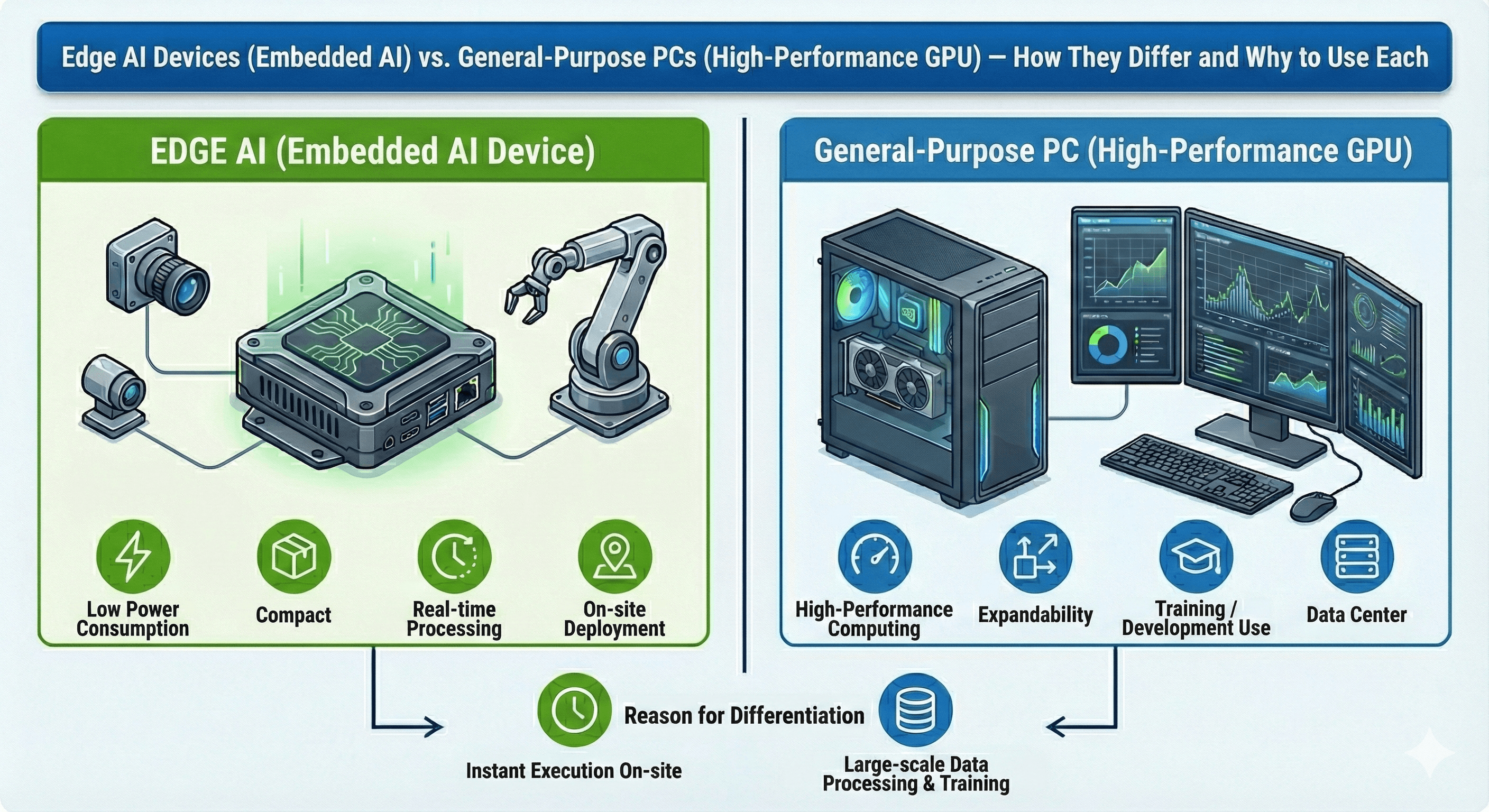
Edge AI devices and general-purpose PCs (desktop PCs/laptops) are both broadly classified as "computers". However, their design philosophies, operating environments, and applications they excel at can differ significantly. This article will clarify the differences (suitability and unsuitability) using NVIDIA’s "Jetson" and "RTX"—two names frequently mentioned in the context of video AI—while also explaining why edge AI devices are preferred.
Table of Contents
First, let's clarify: Edge AI devices are a type of PC
Differences between Jetson and RTX (suitability and unsuitability)
What general PCs equipped with RTX excel at (and their price range)
Reasons why edge AI devices are still necessary
Common issues when substituting with RTX-equipped PCs
Reasons why Zenmov × EDGEMATRIX can say, "Operations are easy"
Conclusion
Note: Why NVIDIA is frequently used in edge AI (CUDA Ecosystem/CUDA Tile)
1. First, let's clarify: Edge AI devices are a type of PC
Edge AI devices (edge PCs, industrial AI devices, etc.) share the basic structure of computers with general-purpose PCs in the sense of input (camera footage/sensors) → processing (AI inference) → output (notifications/control/storage). However, "PC" usually refers to desktop PCs or laptops used in offices or homes, so in this article, we'll differentiate between "general-purpose PCs (RTX-equipped PCs)" and "edge AI devices (devices equipped with Jetson)" for clarity.
To summarize briefly:
General PCs (RTX-equipped PCs): High-performance general PCs designed to work in stable indoor environments and cater to a wide range of applications.
Edge AI devices (devices equipped with Jetson): Purpose-built PCs optimized for field use.
2. Differences between Jetson and RTX
Here, we'll highlight NVIDIA products frequently mentioned in video analysis contexts. Jetson is a "compact computer designed to be placed in the field", while RTX refers to "high-performance GPU cards inserted in PCs and servers".
Jetson (for edge applications)
An edge-focused platform that integrates ARM CPU and GPU
Emphasizes compact size, low power consumption, and continuous operation (designed for field deployment)
Easily enables real-time inference on-site when combined with cameras and sensors
Often integrated into devices with environmental resistance (dust-proof, vibration-resistant, etc.)
RTX (for general PCs/servers)
Mainly a discrete GPU (card) installed in PCs/servers
Attractive due to overwhelming GPU performance and price competitiveness (suitable for a wide range of applications)
Can accommodate general uses like PC tasks, development environments, and testing
However, installation is generally limited to indoor environments (requires electrical supply, cooling, and chassis space)
3. What general PCs equipped with RTX excel at (and their price range)
In conclusion, general PCs equipped with RTX are highly appealing in terms of "performance" and "price". Especially in environments such as proof of concept (PoC) testing or server rooms and offices with air conditioning, they become a realistic option.
Performance: High GPU performance enables broad applicability from video analysis to large model verification
Flexibility: Uses general-purpose OS (Windows/Linux, etc.), allowing software to be configured freely according to application
Cost: Depending on the configuration, achieving equivalent inference performance can sometimes result in a "good cost-performance case"
Can also handle typical PC tasks (development, editing, analysis, etc.) with the same unit
〈Price Guidelines〉※As of 2025
Prices vary significantly based on GPU generation, CPU and memory, chassis (industrial or not), and procurement routes (retail/BTO/business-focused). Here’s a summary of price ranges observed domestically, provided as a guideline.
Category | Price Range (New) | Notes |
Desktop PC equipped with RTX | Generally centered around 120,000 to 350,000 yen (high-end models can exceed 500,000 yen) | Wide range available in BTO/retail. Fluctuations based on GPU generation and peripheral configurations |
Edge PCs equipped with Jetson (Typical small models) | Approximately 200,000 to 400,000 yen | Most structures focus on compact size and low power consumption |
Industrial rugged edge PCs equipped with Jetson | Can be around 300,000 to over 800,000 yen | Higher due to "chassis requirements" like dust and vibration resistance |
It is not uncommon for "RTX-equipped PCs to appear higher-performing and cheaper". Yet, the choice for edge AI devices is heavily influenced by the operational conditions to be discussed in the next chapter.
4. Reasons why edge AI devices are still necessary
While it is possible to "just run AI" on general-purpose PCs, for example, detecting whether "a car is visible" or "a person has passed" in camera footage can be processed with an office PC.
On the other hand, the real value of edge AI devices emerges under the following field conditions:
Installed in "the field", such as parking lots, factories, stores, roads, and facility entrances
Required to continuously operate 24/7 without stopping
Harsh environments with heat, cold, dust, vibration, etc.
Constraints on power supply and installation space (low power consumption and compact size are crucial)
Edge AI devices (edge PCs) were born to meet these demands. Although edge devices are also PCs, they optimize the parts that are often used for AI (like GPUs) and minimize elements that may be unnecessary in field deployments, enhancing the cost-performance and operability for continuously running inference.
Next, comparing Jetson and RTX, the differences become clearer.
5. Common issues when substituting with RTX-equipped PCs
The idea of "simply placing a general-purpose PC equipped with RTX in place of Jetson" is quite natural. However, when trying to meet the "field requirements" that edge AI addresses, several issues are likely to arise.
① Increased operational costs and inefficiencies
Energy costs are likely to rise (the more units, the bigger the impact)
High heat generation often necessitates cooling, dust-proofing, and noise control measures
Installation may become difficult in locations with power or space constraints, such as outdoor or vehicle-mounted settings
② Difficulty ensuring real-time performance and reliability
Dust, vibration, temperature changes, etc., increase the risk of failure (stopping can cause issues on-site)
Need to establish and monitor continuous operation design for OS updates and reboots
Each location's wiring, installation, remote monitoring, and recovery procedures require increased maintenance design
To summarize, while RTX-equipped PCs possess high processing power, it is challenging to keep them running continuously on-site 24/7. Additionally, it often requires building a maintenance and support system from scratch, leading to a potentially heavy burden. The value of edge AI devices lies in their ability to absorb these burdens as a packaged product, facilitating on-site deployment.
6. Reasons why Zenmov × EDGEMATRIX can say, "Operations are easy"
Up to this point, you may have further crystallized the question, "If RTX is often high-performing and cheap, why are edge devices necessary?" When considering the operational aspects, edge AI devices are "PCs packaged for AI field operations", resulting in a significant difference in post-deployment burden.
The Jetson-based edge AI devices handled by Zenmov allow for management mainly through a dashboard, including:
Device bulk management: Device list, operational status (online/offline), temperature and resource usage health checks, etc.
AI application/model distribution: Remote implementation of application installation/updates, configuration distribution, and reboots
Camera/input management: Stream settings, regions of interest (ROI), and detection condition settings
Alerts/logs: History of detected events, log collection, alert notification settings
Streamlining operations: Standardizing procedures that tend to vary by site to facilitate maintenance and recovery
While aiming for the same operations with general-purpose PCs (equipped with RTX) is possible, it requires a significant amount of in-house design for monitoring, updates, log collection, and recovery during failures, which intensifies operational burdens as the scale increases.
7. Conclusion
General PCs equipped with RTX offer an excellent balance of performance and price, making them very strong contenders for PoCs and indoor operations. In contrast, edge AI devices are specifically designed for "low power consumption, environmental durability, continuous operation, and remote operation", thus providing comprehensive peace of mind and reduced operational burdens for applications that require continuous operation on-site.
PoC and indoor testing: RTX-equipped PCs are strong contenders (high performance, flexibility, cost-effective)
Continuous operation in the field: Edge AI devices equipped with Jetson are strong contenders (low power consumption, environmental durability, standardized operations)
Note: Why NVIDIA is frequently used in edge AI (CUDA Ecosystem)
The background behind the frequent usage of NVIDIA products in the edge AI field is not only their hardware performance but also the robust "CUDA ecosystem (development infrastructure)" that strongly supports development.
CUDA Ecosystem: The parallel computing platform "CUDA" is widely used as the de facto standard in the AI/deep learning field.
Compatibility with major frameworks: Major frameworks like TensorFlow and PyTorch are optimized for NVIDIA GPUs, facilitating easy transitions from training to inference.
Rich libraries/SDKs: An abundance of SDKs for specific uses such as image recognition, video processing, inference optimization, and robotics contributes to reduced development time and costs.
As a result, it becomes easy to connect training (server side) and inference (edge side) within the same NVIDIA stack, yielding advantages in overall operational predictability.
In recent years, initiatives such as the introduction of "CUDA Tile (tile-based programming model)" in CUDA Toolkit 13.1 and "cuTile Python" aimed at Python users have progressed, making CUDA more accessible to them.